
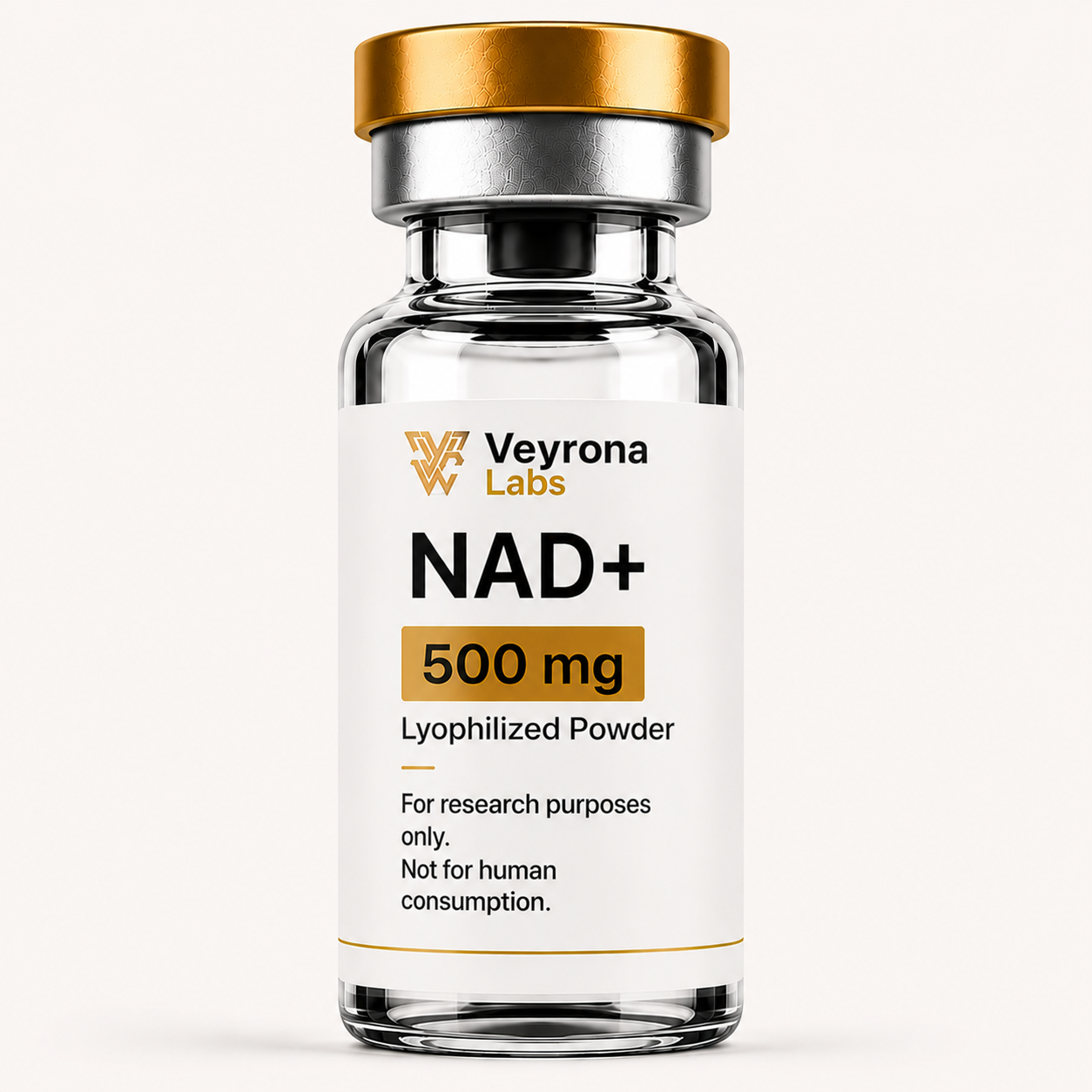
NAD+ 500 mg
NAD+ is a coenzyme found in every living cell. Researchers use it to study how cells transfer energy, maintain metabolic balance and coordinate repair and signalling processes.
Why do researchers study NAD+?
Energia komórkowa
How cells move energy between metabolic reactions.
Mitochondria
Energy production and the balance between NAD+ and NADH.
Cell maintenance
NAD+-dependent enzymes involved in repair and regulation.
Sygnalizacja metaboliczna
Communication between nutrient status, stress responses and cell activity.
What is NAD+?
Nicotinamide adenine dinucleotide, usually shortened to NAD+, is a small cellular coenzyme rather than a peptide. It can accept and transfer electrons, which makes it central to energy metabolism.
NAD+ also serves as a working material for enzymes involved in DNA maintenance, protein regulation and cellular signalling.
A link between energy and cell maintenance
Cells continually convert NAD+ to NADH and back again while processing nutrients and producing energy. This cycle connects glycolysis, the citric-acid cycle and mitochondrial energy production.
Other enzymes consume NAD+ during signalling and repair reactions. Research therefore examines both the total amount of NAD+ and how it moves between cellular compartments.
Co wykazały badania?
Energy transfer
NAD+ accepts electrons during metabolic reactions and carries them in the form of NADH, helping researchers follow how cells process energy.
Metabolic balance
The NAD+/NADH balance is studied as an indicator of how mitochondria and other cellular systems respond to nutrients and stress.
Sirtuins, PARPs and CD38
NAD+ is used by several enzyme families that connect cellular energy status with DNA maintenance, protein regulation and signalling.
NAD+ homeostasis
Researchers examine how NAD+ production, recycling and consumption change across tissues and experimental models over time.
Wybrane badania
- Covarrubias AJ i in. Metabolizm NAD+ i jego rola w procesach komórkowych zachodzących w procesie starzenia. Nat Rev Mol Cell Biol. 2021;22:119–141.
- Verdin E. NAD+ w starzeniu się, metabolizmie i neurodegeneracji. Science. 2015;350:1208–1213.
- Belenky P, Bogan KL, Brenner C. NAD+ metabolism in health and disease. Trends Biochem Sci. 2007;32:12–19.
Szczegóły produktu w skrócie
01Obszary badań⌄
NAD+ is studied in cellular energy transfer, mitochondrial function, redox balance, DNA maintenance and enzyme signalling.
02Co zawiera opakowanie⌄
One sealed laboratory vial containing 500 mg of freeze-dried NAD+ research material.
03Przechowywanie produktu liofilizowanego⌄
Przechowywać zamkniętą fiolkę z liofilizowanym produktem w temperaturze −20°C, w suchym miejscu i chronić przed światłem. Przed otwarciem pozostawić zamkniętą fiolkę do osiągnięcia temperatury pokojowej, aby ograniczyć kondensację.
04Przechowywanie po zmieszaniu z wodą BAC⌄
Po przygotowaniu z użyciem wody bakteriostatycznej przechowywać w lodówce w temperaturze 2–8°C, chroniąc od światła. Nie zamrażać; ograniczyć do minimum wielokrotne podgrzewanie i schładzanie.
05Dlaczego fiolka może wyglądać inaczej⌄
Five hundred milligrams of freeze-dried material can form a compact layer or cake at the bottom of the vial. Its appearance can vary with the freeze-drying process.
Wyniki analityczne powiązane z partią produktu
Użyj identyfikatora partii na fiolce, aby znaleźć odpowiadający jej raport analityczny w bibliotece wyników Veyrona Labs. Opublikowane raporty zawierają dane identyfikacyjne, czystość, zmierzoną zawartość oraz wyniki badań endotoksyn dla konkretnej partii.
Wyłącznie do badań laboratoryjnych i analitycznych. Nie do użytku u ludzi ani zwierząt.
Opinie
Na razie nie ma opinii o produkcie.