
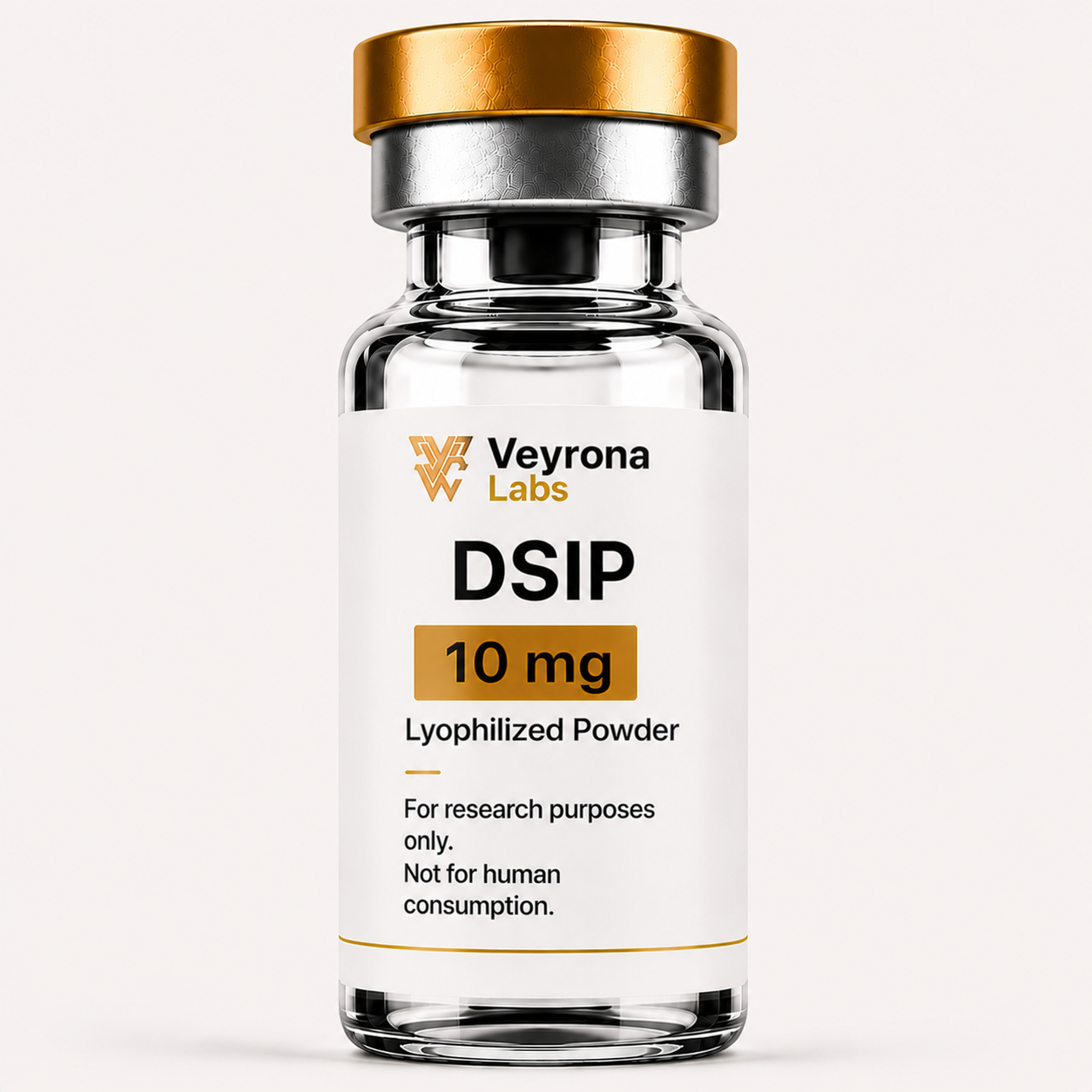

DSIP 10 mg
A nine-amino-acid peptide supplied for controlled laboratory research into sleep–wake regulation, stress physiology and neuroendocrine signalling.
Where DSIP is being investigated
Sleep architecture
EEG-defined sleep stages and sleep–wake organization.
Circadian biology
Temporal patterns of sleep and neuroendocrine responses.
Stress-response systems
Experimental interactions with stress, pain and endocrine pathways.
Peptide identity
Distribution, binding and the unresolved status of an endogenous precursor.
What is DSIP?
Delta sleep-inducing peptide (DSIP) is the nonapeptide Trp-Ala-Gly-Gly-Asp-Ala-Ser-Gly-Glu. It was originally isolated during experiments involving sleep-associated cerebral blood samples and was named from early observations of delta-EEG activity.
Later research identified DSIP-like immunoreactivity in several biological tissues and fluids and expanded the research beyond sleep into stress, pain and neuroendocrine signalling.
What the literature supports
Older controlled and open human experiments examined EEG sleep architecture and chronic insomnia, while animal studies explored sleep, stress, pain and neuroendocrine endpoints. Some studies reported delayed or subgroup-specific changes.
Current research direction
Receptor identification, timing, dose response and modern EEG study design.
Proposed biological pathways
EEG-stage modulation
The original hypothesis centred on slow-wave and delta activity, while later studies broadened the model to include timing-dependent and subgroup-specific responses.
Stress-related signalling
Experimental work has examined interactions with ACTH, cortisol and other neuroendocrine systems as researchers continue to map the underlying receptor pathways.
Precursor and receptor
The search for a definitive mammalian precursor and specific DSIP receptor remains an active part of the research programme.
What does the research show?
Severe chronic insomnia
A 1987 study evaluated 24-hour sleep–wake behaviour in severe chronic insomnia and reported delayed changes in some sleep measures rather than a simple immediate hypnotic effect.
Sixteen chronic-insomnia participants
A 1992 matched-pairs trial in 16 people recorded variable sleep responses and remains a useful reference for designing larger, more precisely timed studies.
Open and controlled observations
Small studies from the 1980s reported changes in selected insomnia groups, while later work highlighted the importance of participant selection and measurement timing.
Active mechanistic questions
DSIP remains relevant for controlled work on timing, EEG measures, receptor biology and exposure patterns.
Selected reading
- DSIP and 24-hour sleep–wake behaviourStudy in severe chronic insomnia · PubMed
- DSIP in chronic insomniaDouble-blind matched-pairs study with 16 participants · PubMed
- Delta sleep-inducing peptide: an updateHistorical review of sleep and extra-sleep research · PubMed
- DSIP: a still unresolved riddleCritical review of biological identity and evidence · PubMed
Batch-specific documentation
Use the batch identifier on the vial to locate its matching analytical report in the Veyrona Labs results library. Published reports present batch-specific identity, purity, measured content and endotoxin results where tested.
For laboratory and analytical research only. Not for human or veterinary use.
Reviews
There are no reviews yet.