
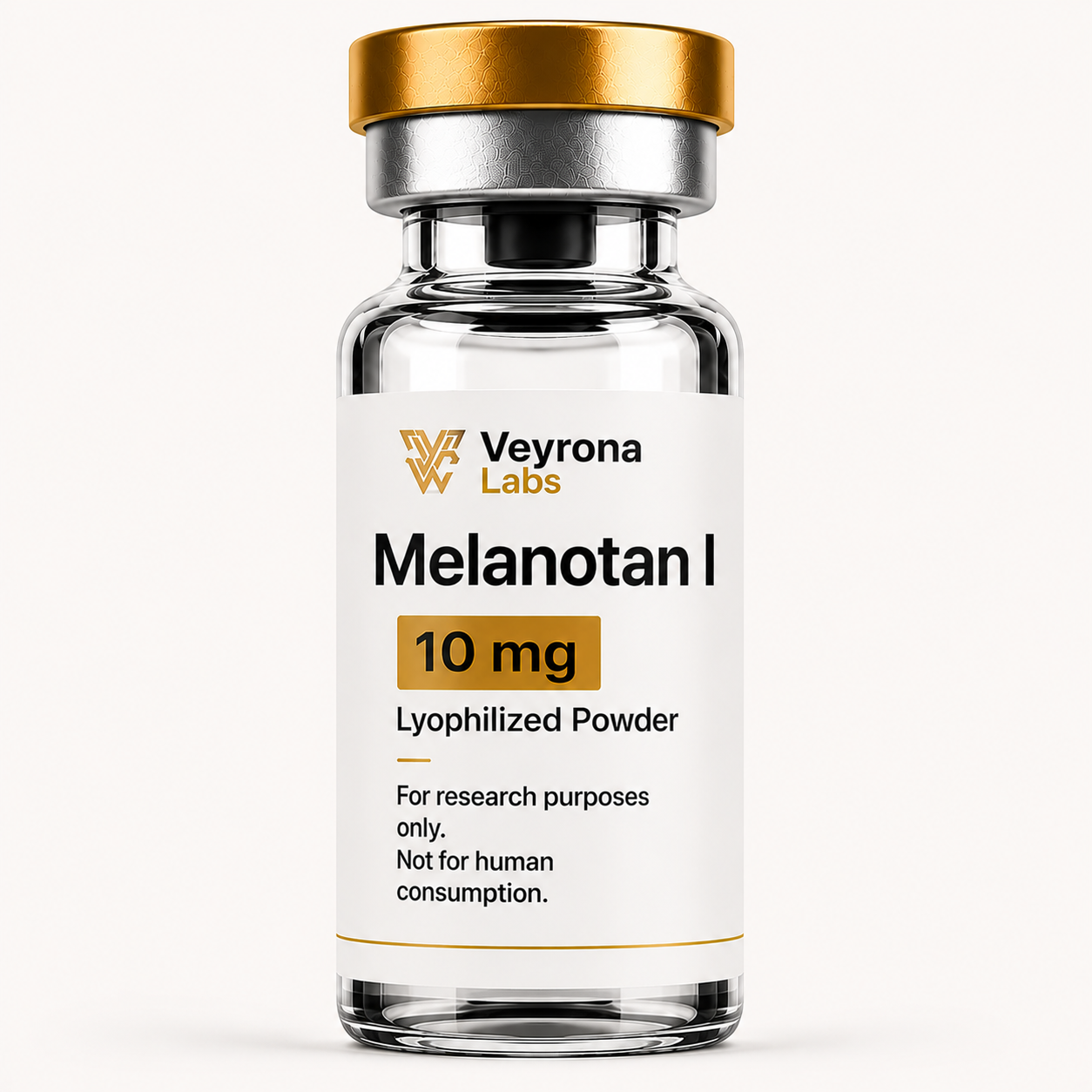

Melanotan I (MT-1) 10 mg
Melanotan I is a synthetic analogue of alpha-melanocyte-stimulating hormone studied in melanocortin-receptor signalling, pigment-cell biology and the production of melanin.
Why do researchers study Melanotan?
MC1 receptor
How pigment-producing cells respond to melanocortin signals.
Melanin production
Formation of eumelanin and changes in pigment-cell activity.
Photobiology
Cellular responses connected with ultraviolet light.
Peptide design
How selected amino-acid changes influence stability and receptor activity.
What is Melanotan I?
Melanotan I is a laboratory-designed version of the natural signalling peptide α-MSH. Two amino-acid modifications make it more stable and increase its activity at melanocortin receptors.
It is also known as afamelanotide, a name used in scientific and pharmaceutical research on this molecular class.
From receptor signal to pigment production
When the MC1 receptor on a melanocyte is activated, it starts an internal signal involving cyclic AMP. This encourages the cell to produce eumelanin, a darker form of melanin.
Researchers use Melanotan I to follow this pathway and to compare how structural changes affect receptor activity and peptide stability.
What have studies found?
Melanocortin signalling
Laboratory studies map how Melanotan I interacts with melanocortin receptors, particularly MC1R on pigment-producing cells.
Eumelanin production
Research examines changes in melanocyte activity and the production of darker eumelanin pigment.
Response to ultraviolet light
Studies connect melanocortin signalling with the way pigment cells respond to ultraviolet exposure.
Stability and activity
Comparisons with natural α-MSH show how the Nle4 and D-Phe7 modifications influence peptide stability and receptor activity.
Selected research
- Dorr RT et al. Increased eumelanin expression and tanning is induced by a superpotent melanotropin [Nle4-D-Phe7]-alpha-MSH in humans. Photochem Photobiol. 2000.
- Langendonk JG et al. Afamelanotide for erythropoietic protoporphyria. N Engl J Med. 2015;373:48–59.
- Brzoska T et al. Alpha-melanocyte-stimulating hormone and related peptides. Endocr Rev. 2008;29:581–602.
Product details at a glance
01Research areas⌄
Melanotan I is studied in melanocortin-receptor activity, melanin production, pigment-cell biology, photobiology and peptide design.
02What the package contains⌄
One sealed laboratory vial containing 10 mg of freeze-dried Melanotan I research material.
03Storage of the freeze-dried product⌄
Keep the sealed freeze-dried vial at −20 °C, dry and protected from light. Let the closed vial reach room temperature before opening to limit condensation.
04Storage after mixing with BAC water⌄
After preparation with bacteriostatic water, keep refrigerated at 2–8 °C and protected from light. Do not freeze; minimize repeated warming and cooling.
05Why the vial can look different⌄
Ten milligrams is a very small mass. The freeze-dried material may form a thin layer or compact deposit at the bottom of the vial.
Analytical results linked to the product batch
Use the batch identifier on the vial to locate its matching analytical report in the Veyrona Labs results library. Published reports present batch-specific identity, purity, measured content and endotoxin results where tested.
LOT: MT1-10MG-A
LiquiLabs · COA published 2026-10-05
COA LYO-0989 · Assay 14.86 mg (10 mg label) · Purity 99.2%
For laboratory and analytical research only. Not for human or veterinary use.
Reviews
There are no reviews yet.