
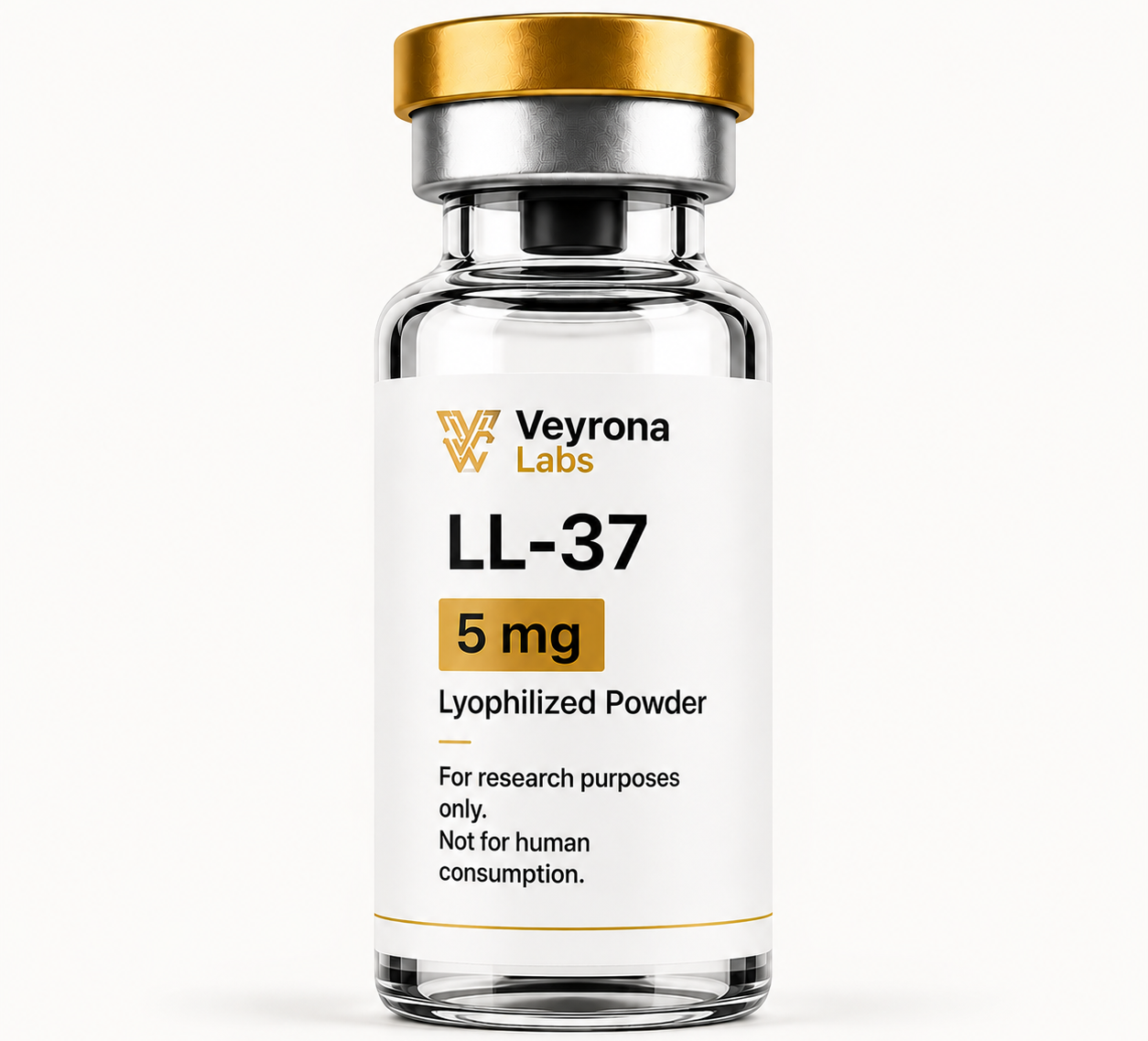

LL-37 5 mg
LL-37 is a human defence peptide studied for its interaction with microbial membranes, immune-cell communication, protective surface tissues and tissue-repair responses.
Why do researchers study LL-37?
Microbial membranes
How the peptide binds to and changes selected membrane structures.
Innate defence
An early layer of biological defence at exposed body surfaces.
Immune communication
Movement and signalling of immune cells in experimental models.
Barrier-tissue repair
Responses of skin and other protective surface tissues after damage.
What is LL-37?
LL-37 is the active 37-amino-acid peptide released from the human cathelicidin precursor hCAP18. It is produced by several immune and surface-tissue cells.
Its positive charge and structure allow it to interact with negatively charged membranes, while separate signalling effects connect it with immune communication and tissue repair.
One peptide with two research roles
LL-37 research combines direct membrane studies with experiments on host-cell signalling. This lets researchers compare physical effects on membranes with biological responses inside cells.
Salt concentration, proteins in the surrounding liquid and peptide concentration are important variables when these activities are measured.
What have studies found?
Interaction with microbial surfaces
Laboratory experiments show that LL-37 can bind to selected microbial membranes and alter their organization.
Chemotaxis and communication
LL-37 is studied in signalling pathways that influence how immune cells move and communicate.
Epithelial responses
Cell and tissue models examine LL-37 in wound closure and the renewal of protective surface layers.
Organized microbial communities
Researchers use LL-37 to study how defence peptides interact with biofilms and their surrounding matrix.
Selected research
- Vandamme D et al. A comprehensive summary of LL-37, the factotum human cathelicidin peptide. Cell Immunol. 2012;280:22–35.
- Dürr UHN, Sudheendra US, Ramamoorthy A. LL-37, the only human member of the cathelicidin family of antimicrobial peptides. Biochim Biophys Acta. 2006;1758:1408–1425.
- Kahlenberg JM, Kaplan MJ. Little peptide, big effects: the role of LL-37 in inflammation and autoimmune disease. J Immunol. 2013;191:4895–4901.
Product details at a glance
01Research areas⌄
LL-37 is studied in microbial-membrane interactions, innate defence, immune-cell signalling, biofilms and barrier-tissue repair.
02What the package contains⌄
One sealed laboratory vial containing 5 mg of freeze-dried LL-37 material.
03Storage of the freeze-dried product⌄
Keep the sealed freeze-dried vial at −20 °C, dry and protected from light. Let the closed vial reach room temperature before opening to limit condensation.
04Storage after mixing with BAC water⌄
After preparation with bacteriostatic water, keep refrigerated at 2–8 °C and protected from light. Do not freeze; minimize repeated warming and cooling.
05Why the vial can look different⌄
Five milligrams is a very small mass. The freeze-dried material may appear as a thin layer or compact deposit at the bottom of the vial.
Analytical results linked to the product batch
Use the batch identifier on the vial to locate its matching analytical report in the Veyrona Labs results library. Published reports present batch-specific identity, purity, measured content and endotoxin results where tested.
For laboratory and analytical research only. Not for human or veterinary use.


Reviews
There are no reviews yet.