
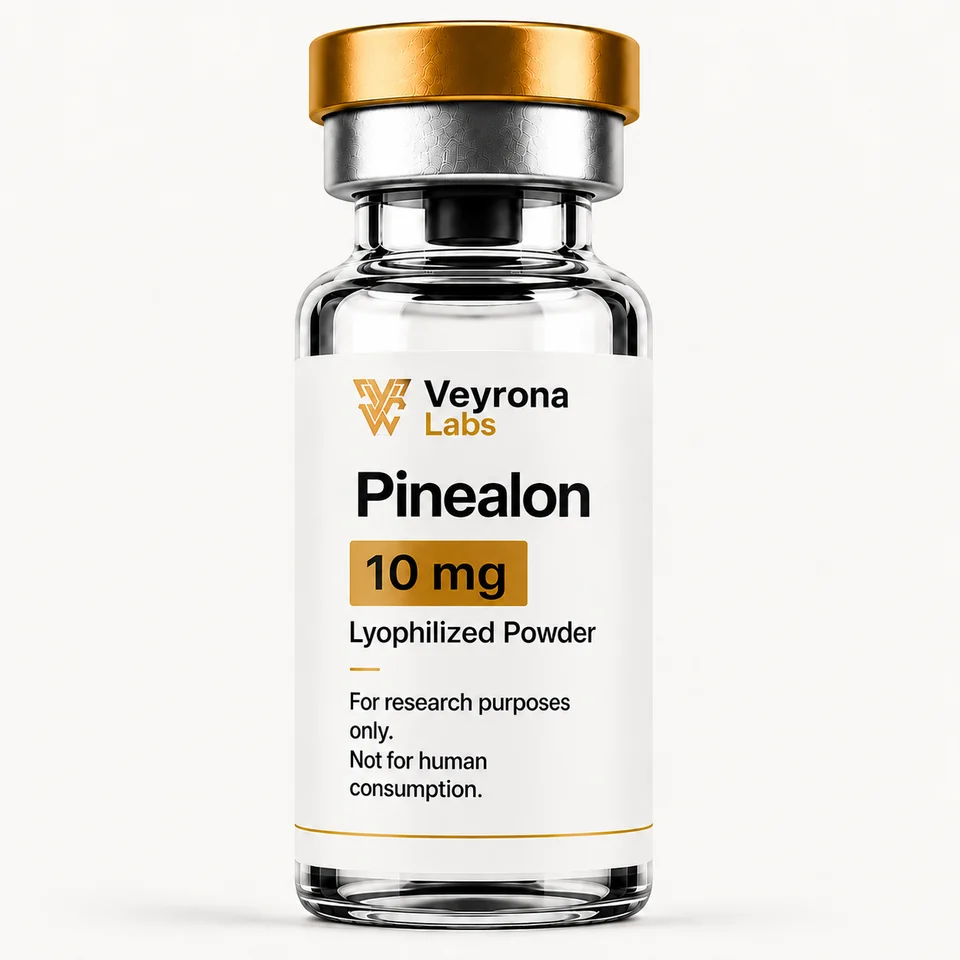

Pinealon 10 mg
A synthetic tripeptide investigated in neuronal stress responses, cell-survival signalling and experimental models of brain ageing.
Where Pinealon is being investigated
Neuronal viability
Survival of nerve-cell populations exposed to experimental oxidative stress.
Oxidative stress
Accumulation of reactive oxygen species and associated cellular injury markers.
Cell signalling
ERK-related responses, gene-expression hypotheses and cellular adaptation.
Learning-related models
Behavioural and neuronal endpoints in selected rodent experiments.
What is Pinealon?
Pinealon is a synthetic peptide composed of glutamic acid, aspartic acid and arginine. Its sequence is abbreviated EDR. Researchers use it to examine how a defined short peptide may influence the response of cells to stress, particularly in experimental nervous-system models.
The name can be confused with other pineal-associated peptides. Pinealon is the three-amino-acid EDR sequence; Epithalon is the different four-amino-acid AEDG sequence. Their experimental findings and proposed mechanisms should be assessed separately.
Biological pathways in the research
The cellular stress response
A 2011 study tested Pinealon in several cell systems, including cerebellar neurons and PC12 cells. Researchers reported reduced accumulation of reactive oxygen species and less necrotic cell death under the tested conditions. The relevance depends on the model and experimental conditions.
Signalling and cell-cycle responses
The same study examined changes in the timing of ERK 1/2 activation and cell-cycle behaviour. These results suggest that the experimental response is more complex than a simple antioxidant effect. They do not establish a complete mechanism in humans.
Synaptic and regulatory hypotheses
Research on EDR also examines neuronal structure and possible regulation of gene expression. A 2021 experimental publication investigated EDR and KED in models related to Alzheimer’s disease. These model-based investigations should not be interpreted as evidence that Pinealon treats dementia.
What does the research show?
Viability under oxidative stress
The initial cell work provides a basis for studying oxidative-stress and survival endpoints together. It supports follow-up experiments rather than a claim of proven protection in people.
Prenatal hyperhomocysteinaemia
A study of rat offspring exposed to a specific prenatal metabolic-stress model reported changes in spatial learning and neuronal resistance to oxidative stress after maternal Pinealon treatment. This specialised animal model is not equivalent to supplementation in healthy adults.
Neuronal connections
A study of short tripeptides explored neuronal and dendritic-spine endpoints in Alzheimer-related mouse models. This extends the range of experimental questions without establishing clinical efficacy.
From a model to a clinical claim
The strongest references presented here concern cell and animal research. They do not establish reliable cognitive enhancement in healthy people, a treatment for neurological disease or an effective human dosing regimen. Independent replication and well-designed clinical studies remain important.
Selected reading
- Pinealon, oxidative stress and cell viability2011 · Cell-based experimental study
- Pinealon in a prenatal hyperhomocysteinaemia model2012 · Rat study
- Neuroprotective effects of tripeptides in an Alzheimer-related model2021 · Experimental study
Understanding the Pinealon research
What oxidative-stress measurements mean
Reactive oxygen species are molecules involved in cellular signalling that can also contribute to damage when their production exceeds cellular control. Pinealon research examines their accumulation together with cell viability. Measuring both helps distinguish a change in a stress marker from a change in the number of surviving cells under the particular experimental conditions.
Why dendritic spines are studied
Dendritic spines are small projections involved in many connections between nerve cells. Changes in their number and structure are useful experimental endpoints in neuroscience. Studies of EDR examine these structural observations alongside cellular and behavioural findings. A result in a cultured neuron or a disease model answers a narrower question than a demonstrated improvement in human memory.
Product details at a glance
What the package contains
One laboratory vial labelled Pinealon 10 mg, supplied as lyophilized research material. The labelled peptide amount describes nominal content; it does not specify the total mass of peptide, counterions, residual water or any formulation ingredients.
Reading the molecular specification
The molecular formula and molecular weight above refer to the reference peptide. They are distinct from measured vial content and do not confirm the salt form of the supplied batch. The sequence can be checked against PubChem CID 10273502.
Purity and content answer different questions
Chromatographic purity describes the relative chromatographic signal assigned to the peptide under a particular test method. Peptide content measures an amount. A purity percentage alone does not confirm the labelled milligram content, sterility or endotoxin status; each requires its own appropriate assessment.
Use the documentation for the supplied material
Store the sealed freeze-dried vial at −20 °C, dry and protected from light. Before opening, allow the closed vial to reach room temperature to limit condensation. After preparation with bacteriostatic water, store at 2–8 °C, protected from light. Do not freeze the prepared solution and minimize repeated warming and cooling. Record the preparation date and follow the batch documentation for the applicable use-by period.
Batch-specific analytical information
Published research describes the peptide sequence; it does not verify the identity or quality of an individual vial. Match the lot identifier to its own analytical report. Purity, measured content and endotoxin findings should only be quoted where the corresponding tests have been performed and documented.
For laboratory and analytical research only. Not for human or veterinary use.
Reviews
There are no reviews yet.