
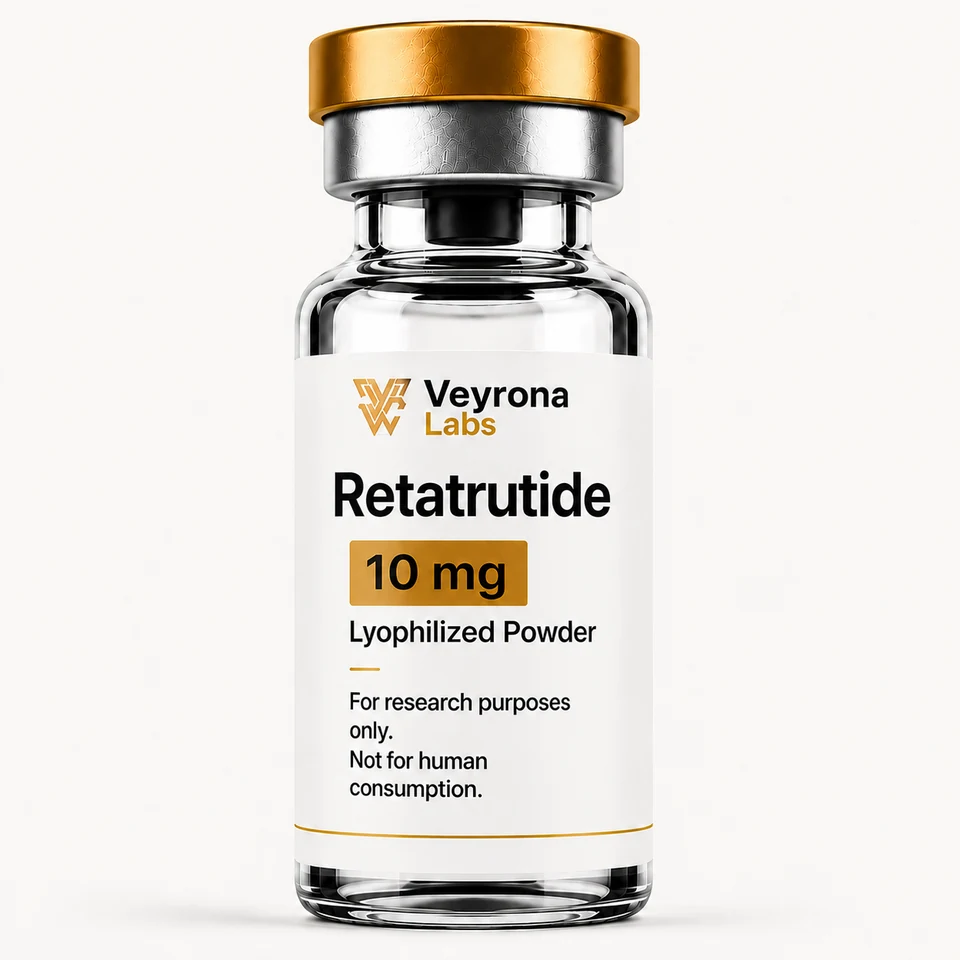

Retatrutide (RETA) — GLP3-R3TA (LY3437943)
An investigational single-molecule agonist engineered to engage the GIP, GLP-1 and glucagon receptors—three interconnected signalling systems studied in metabolic regulation, energy balance and glucose homeostasis.
20 mg: Bacteriostatic water — 2 ml per vial
30 mg: Bacteriostatic water — 3 ml per vial
What is Retatrutide (RETA / GLP3-R3TA)?
GLP3-R3TA, also designated LY3437943, is a synthetic peptide developed as a triple agonist of the glucose-dependent insulinotropic polypeptide receptor (GIPR), glucagon-like peptide-1 receptor (GLP-1R) and glucagon receptor (GCGR). Unlike single GLP-1 receptor agonists or dual GIP/GLP-1 receptor agonists, its design adds glucagon-receptor activity to the incretin signalling profile.
The molecule has progressed from early pharmacology and Phase 1 studies into a broad Phase 3 clinical-development programme. Published research now covers receptor activity, dose response, body-weight change and a wide range of cardiometabolic markers.
Mechanism of Action
Retatrutide is designed to activate three class-B G-protein-coupled receptors. Scientific interest centres on the balance of these signals rather than on any receptor acting in isolation.
GIP receptor
GIPR signalling participates in nutrient-responsive endocrine activity, including glucose-dependent insulin secretion. In a triple-agonist system it is studied alongside GLP-1R and GCGR activity as part of an integrated metabolic response.
GLP-1 receptor
GLP-1R activation is associated with glucose-dependent pancreatic signalling, central appetite pathways and effects on gastric emptying. The relative contribution of each pathway depends on exposure, receptor balance and the experimental model.
Glucagon receptor
GCGR signalling adds hepatic substrate-mobilisation and energy-expenditure biology. Its inclusion distinguishes retatrutide from single- and dual-incretin approaches and is a central focus of mechanistic research.
Key Research Areas
Body weight and energy balance
Dose-dependent changes in body weight, waist circumference and energy-balance endpoints have been central outcomes in obesity trials.
Glycaemic regulation
Studies in type 2 diabetes examine HbA1c, fasting glucose and the interaction of incretin and glucagon-receptor signalling.
Liver fat and lipid metabolism
Dedicated analyses have evaluated liver-fat content, triglycerides and other markers of metabolic liver health.
Cardiometabolic risk markers
Clinical programmes include blood pressure, non-HDL cholesterol, inflammation-related markers and cardiovascular outcomes.
What Does the Research Show?
The studies below present results from defined clinical-trial groups together with their duration, dose and study design, making the development programme easy to compare at a glance.
Mean body-weight change at 48 weeks
The 12 mg group reached a mean change of −17.5% at 24 weeks and −24.2% at 48 weeks. The placebo group changed by −2.1% at 48 weeks. The trial was randomized, double-blind and placebo-controlled.
Mean body-weight change at 68 weeks
Reported for the 12 mg group among participants with obesity or overweight and knee osteoarthritis. WOMAC pain and physical-function endpoints were also assessed. Full peer-reviewed publication should be distinguished from company-reported topline results.
Mean body-weight change at 80 weeks
In participants without diabetes, 45.3% of those assigned to 12 mg achieved at least 30% body-weight reduction. A prespecified higher-BMI extension continuing to 104 weeks was reported separately.
Mean body-weight change at 80 weeks
Reported for the 12 mg group in adults with type 2 diabetes and obesity or overweight, alongside mean HbA1c reductions of up to approximately 1.6 percentage points across the reported programme analysis.
Research & Publications
- Urva S et al. LY3437943, a novel triple GIP, GLP-1 and glucagon receptor agonist: early clinical pharmacology and proof of concept. Cell Metabolism (2022). PubMed record.
- Rosenstock J et al. GLP3 in people with type 2 diabetes: randomized Phase 2 trial. The Lancet (2023);402:529–544. PubMed record.
- Jastreboff AM et al. Triple–Hormone-Receptor Agonist GLP3 for Obesity — A Phase 2 Trial. New England Journal of Medicine (2023);389:514–526. Full publication.
- Sanyal AJ et al. Triple hormone receptor agonist GLP3 for metabolic dysfunction-associated steatotic liver disease: Phase 2 substudy. Nature Medicine (2024). PubMed record.
- TRIUMPH clinical programme. Current Phase 3 studies and registered protocols. ClinicalTrials.gov.
Phase 3 items are clearly identified as company-reported topline data or peer-reviewed publications, so readers can see the source and stage of each result.
Independent Laboratory Testing
The analytical panel below presents the tested 10 mg batch RT10-26001. Every additional strength and production lot is linked to its own batch identifier and laboratory report.
Investigational molecule in Phase 3 development
For laboratory and analytical research only. Not for human or veterinary use.

peptidy –
Almost nobody si testing for endotoxins..Thank you!