
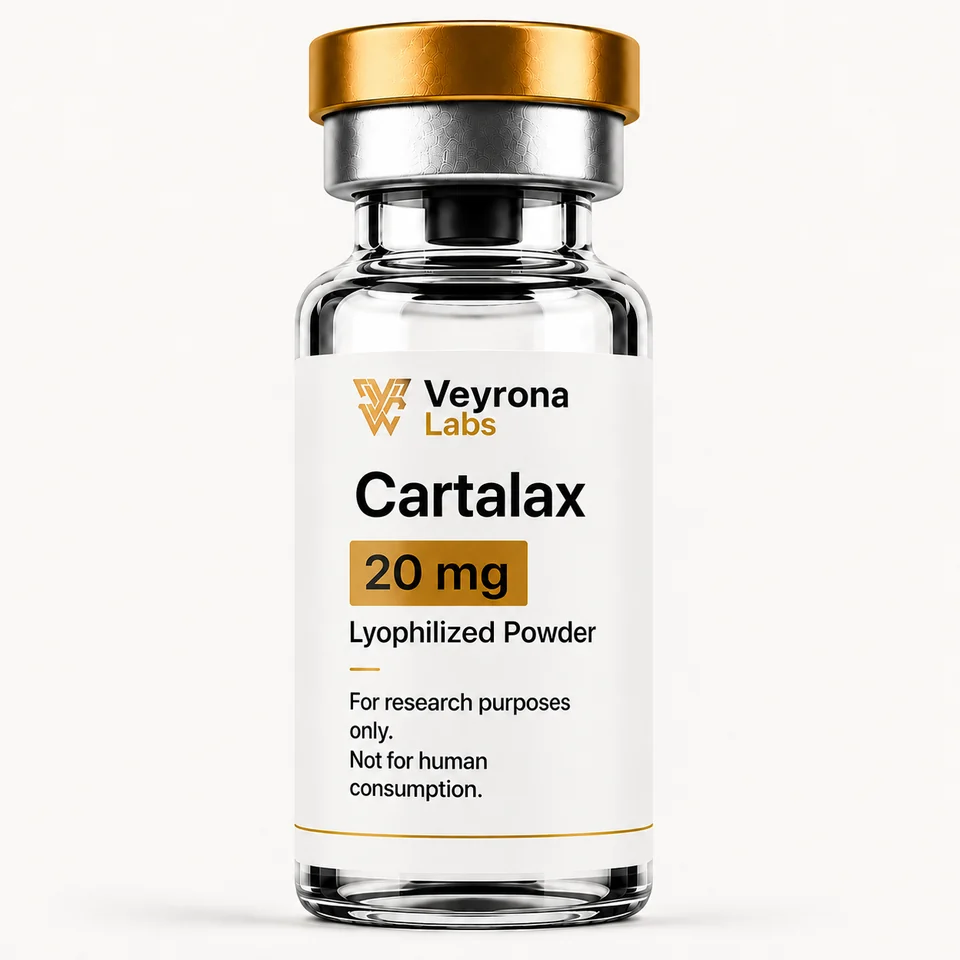

Cartalax 20 mg
A defined three-amino-acid research peptide investigated in cartilage-related cell models, connective-tissue biology and cellular ageing.
Where Cartalax is being investigated
Cartilage-forming cells
Expression of markers associated with chondrogenic differentiation in mesenchymal stem-cell cultures.
Extracellular matrix
Cellular processes involved in the production and remodelling of the material surrounding connective-tissue cells.
Cellular ageing
Changes in gene expression as cultured cells undergo repeated division or prolonged culture.
Fibroblast biology
Proliferation, matrix-remodelling and apoptosis markers in experimental fibroblast cultures.
What is Cartalax?
Cartalax is a synthetic tripeptide made from alanine, glutamic acid and aspartic acid. Its sequence is abbreviated AED in the scientific literature. This precise sequence is useful when comparing research papers, because studies may use the sequence name without mentioning the commercial name Cartalax.
Research focuses on how short peptide signals affect cellular activity, including the expression of genes and proteins associated with differentiation and ageing. Cartilage-related work examines whether cells retain or develop the characteristics needed to produce cartilage matrix. Such laboratory endpoints are different from demonstrating repair of an injured joint.
Biological pathways in the research
Chondrogenic differentiation
AED has been examined alongside a cartilage polypeptide complex in ageing human mesenchymal stem cells. The study measured SOX9, aggrecan, type II collagen and COMP. These markers help describe a cartilage-associated cell phenotype; they do not by themselves establish the formation of mechanically functional cartilage.
Ageing-related regulation
A 2020 cell-culture study examined AED and related peptides against IGF1, FOXO1, TERT, TNKS2 and NFκB expression. The findings place AED within research on cellular regulation and show why the model of ageing matters when interpreting results.
Fibroblast responses
A 2016 study of ageing fibroblast cultures reported changes in MMP-9, Ki-67 and CD98hc with the tested short peptides. AED was also associated with reduced caspase-dependent apoptosis in that model. These are experimental cellular observations rather than established clinical outcomes.
What does the research show?
Cartilage-associated differentiation
The cartilage-focused study investigated gene expression and protein synthesis during replicative ageing of human mesenchymal stem cells. Its value lies in identifying measurable molecular responses for further study.
The influence of the ageing model
AED was studied with other short peptides in cultures aged using different methods. Results from one peptide or culture condition should not automatically be assigned to every member of the group.
Connective-tissue cell markers
The fibroblast work adds a separate experimental perspective on cell proliferation, survival and matrix remodelling. It is relevant background, but it is not a clinical trial of cartilage repair.
What remains to be established
The cited studies support a preclinical research rationale. They do not establish that this product restores human cartilage, treats osteoarthritis or provides a proven clinical benefit. Reproducibility, tissue-level function and clinical relevance remain distinct questions.
Selected reading
- AED and chondrogenic differentiation2023 · Human mesenchymal stem-cell culture
- Short peptides and ageing-related gene expression2020 · Human mesenchymal stem-cell culture
- Peptide regulation of ageing fibroblast functions2016 · In-vitro fibroblast study
Understanding the Cartalax research
What the research markers mean
Cartilage contains cells surrounded by an extracellular matrix. SOX9 is a regulator associated with cartilage-cell differentiation, while aggrecan and type II collagen are structural components of cartilage matrix. COMP is another matrix-associated protein. Measuring these markers helps researchers describe how a cell culture responds to AED and whether it develops cartilage-associated characteristics.
Why several measurements are needed
Repeatedly dividing cell cultures can change their growth and differentiation behaviour. Researchers therefore examine gene expression alongside protein production, proliferation and cell-survival markers. These measurements answer different questions: a change in a marker may help explain a cellular response, while tissue structure and mechanical performance require separate experiments.
Product details at a glance
What the package contains
One laboratory vial labelled Cartalax 20 mg, supplied as lyophilized research material. The labelled peptide amount describes nominal content; it does not specify the total mass of peptide, counterions, residual water or any formulation ingredients.
Reading the molecular specification
The molecular formula and molecular weight above refer to the reference peptide. They are distinct from measured vial content and do not confirm the salt form of the supplied batch. The sequence can be checked against PubChem CID 87815447.
Purity and content answer different questions
Chromatographic purity describes the relative chromatographic signal assigned to the peptide under a particular test method. Peptide content measures an amount. A purity percentage alone does not confirm the labelled milligram content, sterility or endotoxin status; each requires its own appropriate assessment.
Use the documentation for the supplied material
Store the sealed freeze-dried vial at −20 °C, dry and protected from light. Before opening, allow the closed vial to reach room temperature to limit condensation. After preparation with bacteriostatic water, store at 2–8 °C, protected from light. Do not freeze the prepared solution and minimize repeated warming and cooling. Record the preparation date and follow the batch documentation for the applicable use-by period.
Batch-specific analytical information
Published research describes the peptide sequence; it does not verify the identity or quality of an individual vial. Match the lot identifier to its own analytical report. Purity, measured content and endotoxin findings should only be quoted where the corresponding tests have been performed and documented.
LOT: CPT-CA20-20261002-001
LiquiLabs · COA published 2026-10-05
COA LYO-0991 · Assay 24.2 mg (20 mg label) · Purity >99.8%
For laboratory and analytical research only. Not for human or veterinary use.
Reviews
There are no reviews yet.