
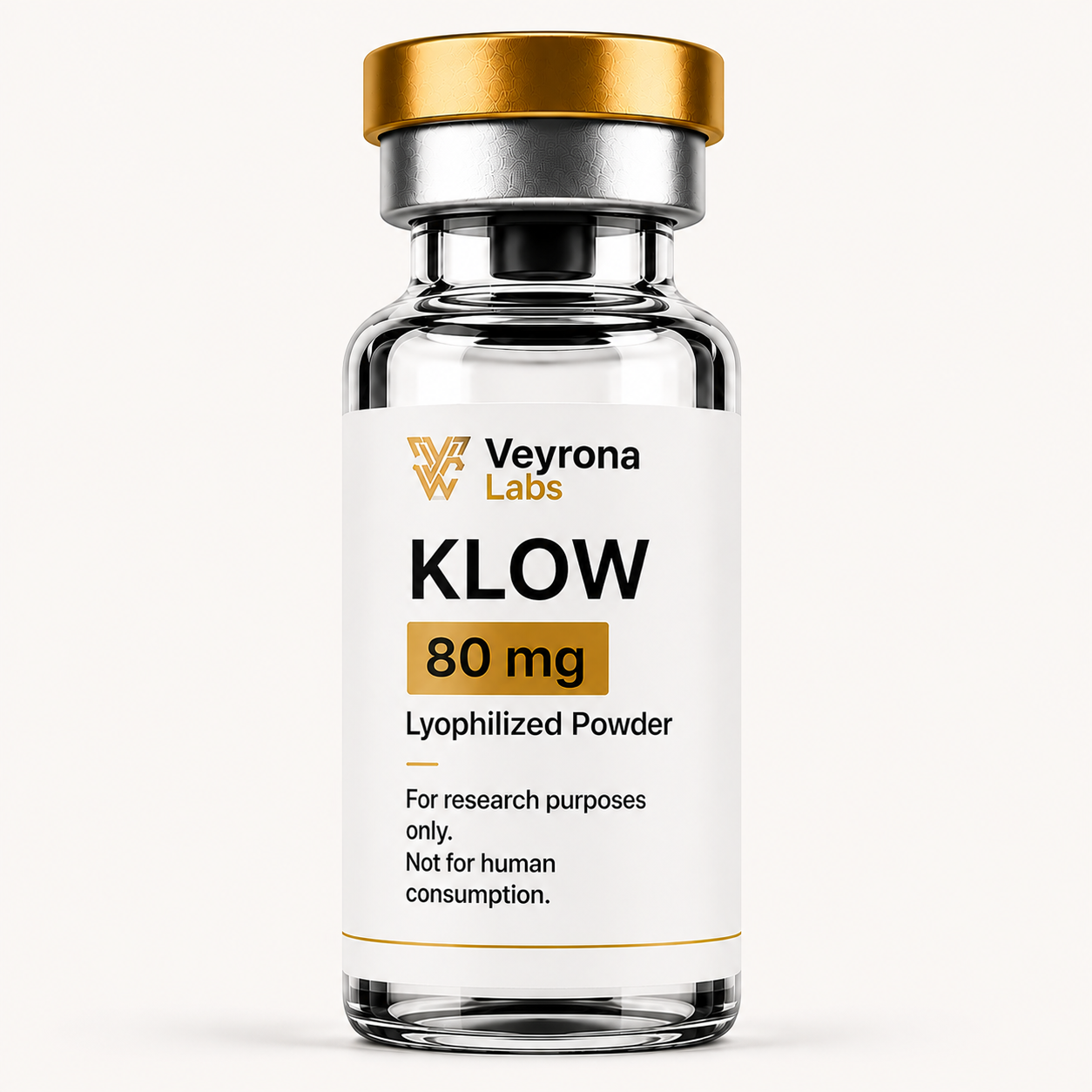

KLOW 80 mg
KLOW combines GHK-Cu, BPC-157, thymosin β4 and KPV in one analytical material for research into component identity, compatibility, stability and connected signalling pathways.
Why do researchers study KLOW?
Tissue renewal
GHK-Cu research into copper binding, collagen and repair signals.
Protective signalling
BPC-157 research into coordinated responses following tissue damage.
Cell movement
Thymosin β4 research involving actin and movement of repair cells.
Immune signalling
KPV research into melanocortin-derived cellular communication.
What is KLOW?
KLOW is a four-component peptide blend. Each component has its own chemical identity and research background, while the finished mixture is analysed as one batch.
Because it is a blend, KLOW does not have one shared amino-acid sequence, molecular formula, molecular weight or CAS number.
Four connected research pathways
The components bring together research on collagen and tissue renewal, protective signalling, actin-related cell movement and immune-cell communication.
Blend-level experiments can measure identity, compatibility and stability while keeping the contribution of each component clear.
What have studies found?
Copper and tissue renewal
GHK-Cu is studied in copper binding, collagen-producing cells and signals connected with renewal of skin and other tissues.
Coordinated repair responses
Cell and animal models examine BPC-157 in repair-cell movement, blood-vessel formation and digestive-system protection.
Actin and cell movement
Thymosin β4 is studied for its relationship with actin, cell migration and repair processes.
Cellular signalling
KPV research focuses on transport across surface tissues and melanocortin-related immune signalling.
Selected research
- Pickart L, Margolina A. GHK peptide as a natural modulator of multiple cellular pathways in skin regeneration. Biomed Res Int. 2015;2015:648108.
- Sikiric P et al. Stable gastric pentadecapeptide BPC 157 and cytoprotection/organoprotection. Gut Liver. 2020;14:153–167.
- Goldstein AL, Hannappel E, Kleinman HK. Thymosin beta4: actin-sequestering protein moonlights to repair injured tissues. Trends Mol Med. 2005;11:421–429.
- Brzoska T et al. Alpha-melanocyte-stimulating hormone and related tripeptides. Endocr Rev. 2008;29:581–602.
Product details at a glance
01Research areas⌄
KLOW combines research themes involving tissue renewal, protective signalling, repair-cell movement and immune communication.
02What the package contains⌄
One sealed laboratory vial containing 80 mg of freeze-dried KLOW blend. The component quantities follow the product label and matching batch documentation.
03Storage of the freeze-dried product⌄
Keep the sealed freeze-dried vial at −20 °C, dry and protected from light. Let the closed vial reach room temperature before opening to limit condensation.
04Storage after mixing with BAC water⌄
After preparation with bacteriostatic water, keep refrigerated at 2–8 °C and protected from light. Do not freeze; minimize repeated warming and cooling.
05Why the vial can look different⌄
Eighty milligrams of freeze-dried blend can form a visible cake, layer or compact deposit. Colour and appearance may reflect the copper-containing GHK-Cu component.
Analytical results linked to the product batch
Use the batch identifier on the vial to locate its matching analytical report in the Veyrona Labs results library. Published reports present batch-specific identity, purity, measured content and endotoxin results where tested.
For laboratory and analytical research only. Not for human or veterinary use.
Reviews
There are no reviews yet.